



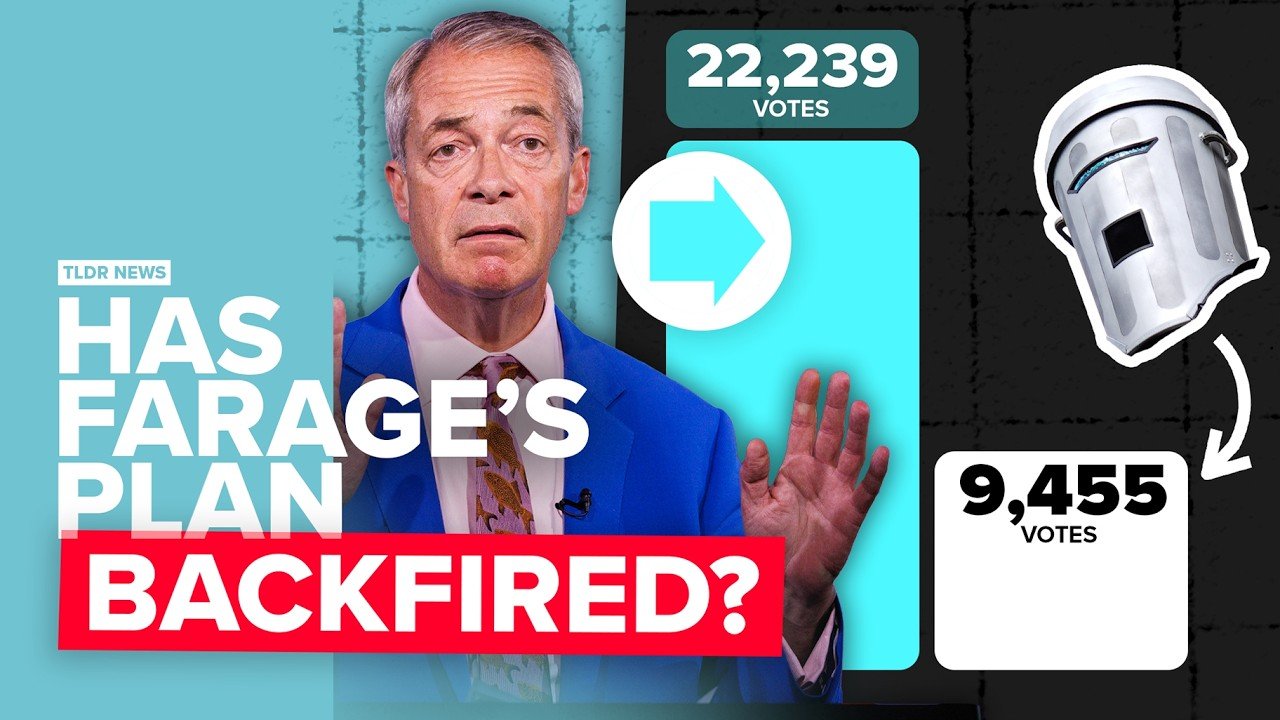
Nigel Farage has comfortably won the Clacton by-election he himself triggered, but the vote has left him facing fresh criticism over its cost and the circumstances that forced it in the first place. The Reform UK leader took 22,239 votes, or 63.3% of ballots cast, in a contest held on 13 August 2026 with a record 34 candidates on the ballot paper.
Thank you for reading this post, don't forget to subscribe!The result was never seriously in doubt. Every major party — Labour, the Conservatives, the Liberal Democrats, the Greens and the smaller Restore Britain — declined to contest the seat, leaving satirical candidate Count Binface as Farage’s most prominent challenger. Binface, a costumed comedian who calls himself an “intergalactic space warrior,” took 9,455 votes, or 26.9%, with the remaining 32 candidates splitting under 10% of the vote between them.
Why the Clacton By-Election Happened
Farage announced on 7 July 2026 that he would resign his Clacton seat, which he had held since the 2024 general election, in order to force a by-election and stand again. According to reporting from CNN, the move came as Farage faced mounting questions over donations to himself and his Reform UK party, including scrutiny of a £5 million gift from Thailand-based donor Christopher Harborne that he had failed to declare before entering Parliament.
Resigning suspended a parliamentary standards investigation into the matter, which would only resume if Farage won and returned to the Commons. Reform UK is also separately facing a police investigation related to allegedly “impermissible” party donations, as CNBC has reported.
Farage cast the snap contest as a personal referendum on his standing rather than an ordinary parliamentary vacancy. Mainstream parties framed their boycott as a refusal to legitimize what Liberal Democrat leader Ed Davey’s camp had earlier branded a “cynical ploy” by Farage to sidestep scrutiny of his finances.
A Landslide Win, But at What Price?
Farage’s victory margin was actually larger in raw vote terms than his 2024 general election result — CNN noted he won 1,000 more votes than he won in the 2024 general election. But turnout was low, at 44.4%, and Binface’s strong second-place finish suggested a sizable anti-Farage vote even in one of Britain’s most Reform-friendly seats.
The bigger political cost has been financial and reputational. UK law requires by-elections to be funded from public money rather than by candidates or parties, and estimates for Clacton’s vote have ranged as high as roughly £250,000, according to CNN. Farage had initially offered for Reform to cover the cost itself, but the offer was rejected because paying for one’s own election would undermine the independence of the democratic process.
Tendring District Council, which administered the vote, said the ballot paper needed to run to roughly 90 centimeters to fit all 34 candidates — the largest field in UK parliamentary election history — which alone cost several times more to print and post than a standard ballot. Left Foot Forward reported a Labour source describing the episode as Farage making “taxpayers pay the cost of his latest ego trip.”
How Commentators and Rivals Are Reacting
Coverage of the result has split sharply along political lines. Sympathetic commentary, such as a widely shared Substack post from a former Reform communications adviser, has framed the win as part of an unbroken run of momentum for the party, while critics — including journalist Jon Sopel, quoted by CNN as calling the crowded field a “circus” — have focused on the spectacle and expense the contest generated.
On TLDR News, hosts explained the mechanics of the by-election and argued that while Farage secured the win he wanted, it came bundled with renewed attention on the donations controversy and the optics of forcing an unnecessary taxpayer-funded vote — the “cost” referenced in the channel’s own framing of the story. That tension between electoral triumph and political liability is likely to shape how Reform’s opponents attack the party in the months ahead, particularly as the suspended parliamentary standards probe into Farage’s finances is now expected to resume.
What Happens Next
With Farage back in the Commons, the Parliamentary Commissioner for Standards is expected to resume its inquiry into the undeclared donation, a process that could itself generate further headlines regardless of its outcome. Left Foot Forward has noted that a further finding against Farage could, in theory, trigger yet another costly by-election down the line.
For now, Reform UK heads into the rest of 2026 with its leader’s Commons seat secured and its polling lead over Labour and the Conservatives largely intact, even as questions about party finances and the price of political theatre continue to trail it.