



Source: Vsauce
Magic Octagon illusion: What You Need to Know
THE TL;DW
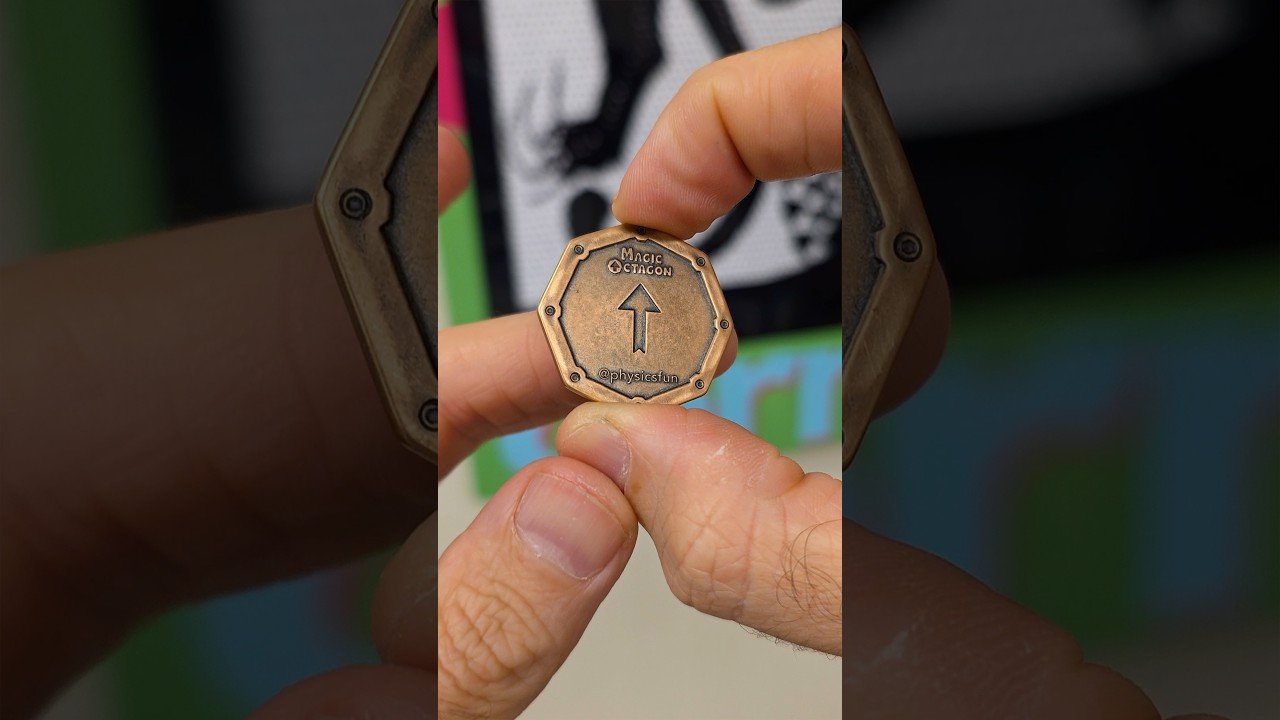
- Vsauce dives into the “Magic Octagon,” a classic brain-teaser coin where two arrows on opposite faces sit 90° apart.
- The video walks through why flipping and rotating the coin makes the arrow’s new direction almost impossible to guess correctly.
- Michael Stevens uses the Magic Octagon illusion to unpack the underlying geometry of rotations, reflections, and parity that make it work.
The Jupiter Take
Vsauce takes a decades-old pocket-sized puzzle and uses it as a springboard into real geometric principles, classic Michael Stevens territory. The Magic Octagon illusion has quietly built a cult following among math teachers and puzzle makers, and this video is likely to send a fresh wave of people hunting for one to try themselves.
Context
The trick itself predates Vsauce by decades. Its roots trace back to a 1946 magic trick called “Screwy Square,” and a formalized version was later written up by Jeremiah Farrell and Tom Rodgers for a Gathering 4 Gardner exchange book, cementing its place in recreational math circles. Math educator Dan Meyer also popularized a video version of the puzzle in classrooms, where students try to predict the arrow’s final position after a series of flips, a task that trips up far more people than expect.
More recently, the puzzle got a physical revival as a 3D-printable and metal “illusion coin,” credited in part to the creator @physicsfun, with the design built around two arrows fixed at a 90-degree angle on either side of an eight-sided token. The challenge boils down to tracking three separate rotations at once, which is why most people’s intuition fails. This is the kind of deceptively simple, deeply explorable topic Vsauce has built a career on, in the same vein as the channel’s recent deep dive into pencil design.