



Source: Veritasium
Veritasium weight into water: What You Need to Know
THE TL;DW
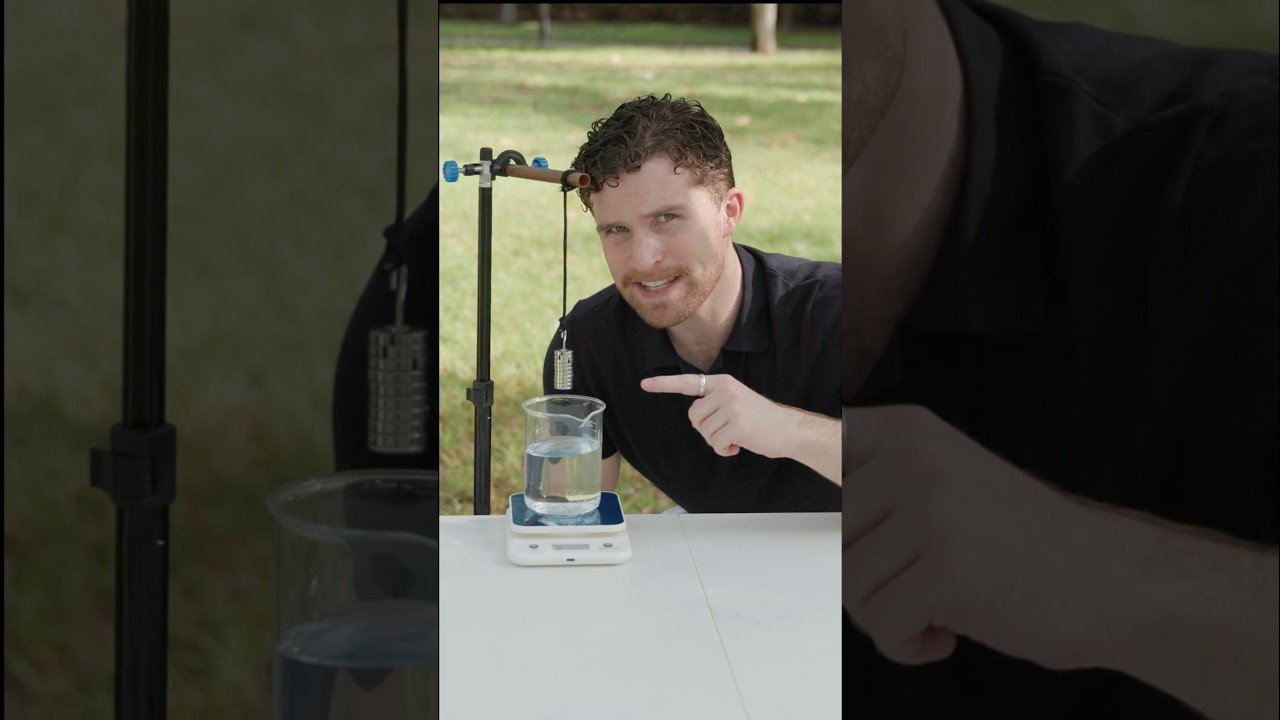
- Veritasium poses a classic physics riddle: lower a weight into a tank of water sitting on a scale — does the reading go up, down, or stay the same?
- The Veritasium weight into water setup tests viewers’ intuition about buoyancy before revealing the counterintuitive answer.
- The result hinges on Newton’s third law — the buoyant force pushing up on the object pushes an equal force back down into the water below it.
The Jupiter Take
This is a quick, bite-sized Veritasium puzzle video rather than a deep dive, built to challenge a common misconception about buoyancy in under two minutes. It’s the kind of demo physics teachers have used for decades, repackaged for a mass audience that often gets the intuitive answer wrong.
Context
The setup Veritasium uses is a staple of introductory physics classrooms: a spring scale measures an object’s weight, then the object is slowly lowered into a container of water that itself sits on a separate weighing scale, and students are asked to predict what that second scale does. The classic answer, confirmed across university physics demonstration archives, is that the scale under the water actually goes up as the object is submerged — even though the object’s own apparent weight drops. That’s because the water exerts an upward buoyant force on the object, and by Newton’s third law, the object pushes back down on the water with equal force, which gets registered by the scale beneath the tank.
Creator Veritasium (Derek Muller) has built his channel’s reputation on exactly this format — taking a seemingly simple physical setup and using it to expose how often people’s gut instincts about basic physics are wrong, a theme that runs through his recent catalog, including his explainer on trapping light to show how fiber optics built the internet. The video arrived as a short, fast-hit format (just over a minute), suggesting it’s designed as a quick engagement piece rather than a full-length deep-dive, likely feeding into a longer companion video or series on fluid mechanics down the line.