



Source: Veritasium
edge dislocation bubble model: What You Need to Know
THE TL;DW
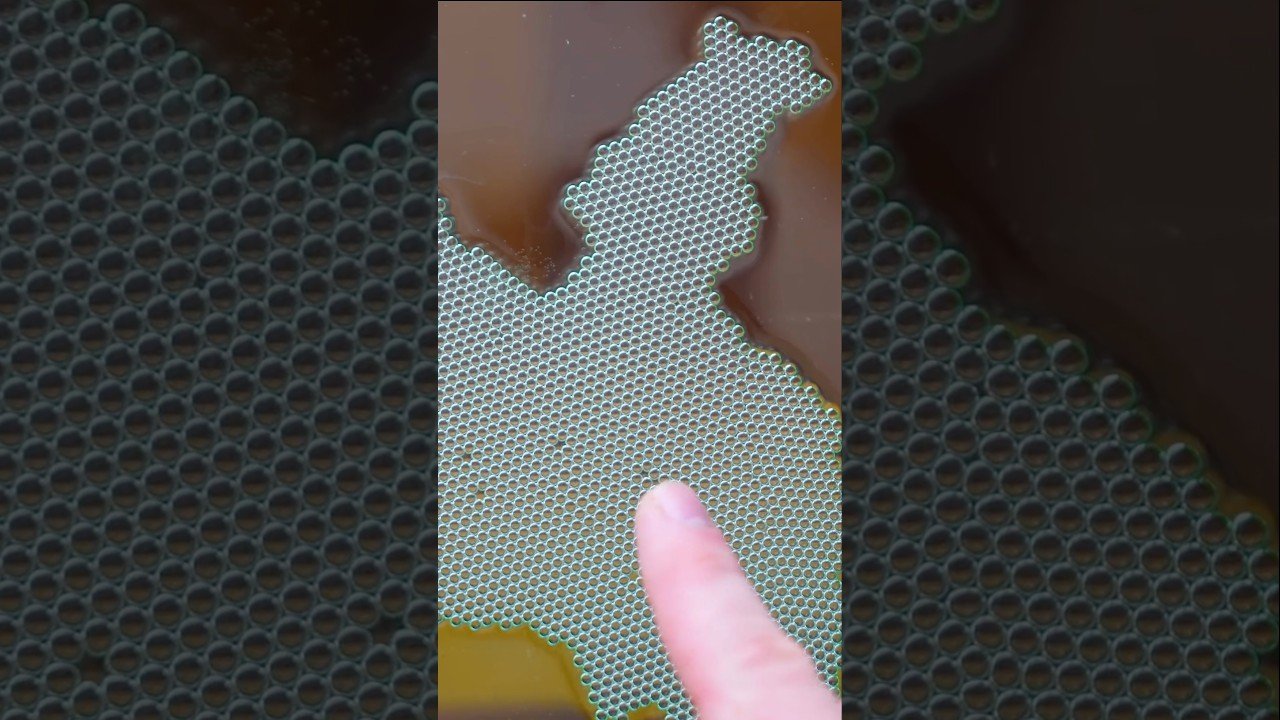
- Veritasium builds a floating raft of soap bubbles to stand in for atoms packed into a crystal lattice.
- The edge dislocation bubble model visually shows an “extra” row squeezed into the lattice, creating a line defect.
- That defect is the mechanism that lets metals and other crystalline materials deform and bend instead of snapping.
The Jupiter Take
This short visual explainer breaks down a core materials-science concept — edge dislocations — using a hands-on bubble analogy instead of dense jargon. It’s a classic Veritasium move: turning an invisible atomic-scale phenomenon into something you can literally watch happen.
Context
The bubble-raft technique Veritasium uses here isn’t new — it traces back to a landmark 1952 experiment by physicists Lawrence Bragg, W.M. Lomer, and J.F. Nye, who first used floating soap bubbles to model how atoms arrange themselves in a crystal and how defects move through that arrangement. In a real 3D crystal, an edge dislocation forms when an extra half-plane of atoms gets wedged into the lattice, creating a line of distortion that can shift through the material under stress, which is exactly what allows ductile metals to bend, stretch, and absorb force rather than fracture outright.
Because bubbles naturally pack into a 2D hexagonal arrangement, they’re a near-perfect physical stand-in for atoms in a lattice, making defects like vacancies and dislocations easy to spot with the naked eye rather than requiring an electron microscope. Understanding dislocations is foundational to materials engineering — it explains everything from why metals work-harden when hammered to why some alloys fail under repeated stress. Veritasium has built a reputation for this kind of hands-on physics demo, and it’s the same channel behind the recent deep dive into how the Enigma code was cracked.